
Sources for Missouri City Past Residents
Previous residents are best researched as a time-ordered address trail. The Fort Bend County Clerk's Official Public Records, or OPR, connects recorded transactions to names and legal descriptions. Dated directories, census material, newspapers, and obituaries add household evidence. Maps and plats explain a lot, road, or changed street label. Each source answers a different question, so a match across sources is stronger than a shared surname or one address line.
| Source | Years | Where Held | What Shows |
|---|---|---|---|
| County OPR | County pages describe 1821-present or 1838-present, depending on series | Fort Bend County Clerk | Parties, document date, instrument, and legal description; it does not search directly by street address |
| Historic probate | 1838-1956 | County Clerk and Odyssey | Estate, executor, heir, and possible land-description clues |
| District historical index | 1821-1980 | Fort Bend District Clerk | Index and minute-book trail with possible party or address context |
| Regional directories | Houston run 1956-2005; Southwest suburban issues 1975-2005 with gaps | UT Briscoe and TSLAC routes | Dated name, address, telephone, and possible household notation |
| Tax rolls and census | Tax rolls 1837-1910 collection; census released under the 72-year rule | TSLAC, FamilySearch, and library microforms | Property or household snapshot, subject to incomplete coverage |
Start with the appraisal and deed path for a recent parcel question. Start with directories, newspapers, tax rolls, or probate when the question is older. A gap is useful information when it is labeled rather than filled with a guess.
Start Missouri City Previous Residents at the Parcel
The Fort Bend Central Appraisal District search is the practical starting point for the current parcel card. Its published controls include owner name, street number, street name, account or Quick Ref ID, geographic ID, subdivision, property type, and tax year. The visible result information can include owner name, mailing address, situs address, legal description, taxing units, value information, and the tax year. Record the displayed field labels and tax year before using the parcel as a bridge to older records.
A parcel card is not proof that an owner lived at the situs address. It may show a mailing address, an entity, or a tax-year snapshot. Its useful role in a previous-residents search is to provide the legal description, subdivision, and stable parcel identifiers that the OPR index needs. Missouri City GIS and the county address layer can resolve a location, but the recorded instrument remains the primary source for legal boundaries.
Note: Preserve the appraisal tax year separately from the deed date, because current parcel fields do not create a historic owner series.
Trace Missouri City Previous Residents Through Deeds
The Fort Bend County Clerk Online Record Search is party and instrument based. Its FAQ says a direct street-address or legal-description search is not available. Resolve the address through FBCAD or GIS first, then use the owner name, legal description, subdivision, or known instrument as a cross-reference. County pages describe millions of documents, but one page gives an 1821-present description while another gives 1838-present. Name the series and verify its coverage rather than claiming one universal first year.
- Copy the current parcel's situs, legal description, subdivision, tax year, and owner field without equating that field with residence.
- Search the recorded index for the current owner or entity, using a narrow filing-date range when known.
- Open the likely purchase instrument and record its document type, instrument number, filing date, grantor, grantee, and legal-description text.
- Search the seller from that deed as a grantee to locate an earlier acquisition, then compare legal descriptions and chronology.
- Repeat only where the next instrument identifies the same parcel or a documented predecessor parcel. Use the County Clerk's copy or image route when the index alone is not enough.
- Grantor
- The party transferring an interest in a recorded instrument.
- Grantee
- The party receiving that interest. A prior owner may appear as a grantee on an earlier purchase.
- Chain of title
- A dated sequence of recorded interests connected by the same legal description or documented parcel change.
- Legal description
- The lot, block, subdivision, survey, or other land description used in the recorded record. It is more stable than a street address when names or layouts change.
The County Clerk's recording page also identifies deeds, mortgages, liens, easements, plats, assumed names, powers of attorney, and bills of sale as recorded series. A recorded name may show a party role, not a past household member. Do not turn a lien, easement, or business filing into an occupancy claim.
Missouri City Previous Residents and Address Changes
An exact street address is the spine of the trail, not the conclusion. Missouri City's street layer can contribute street ranges, left and right ZIP, city, county, odd-even logic, subdivision, section, and update fields. County address points can add aliases or history, postal city, address class, and source dates. Those fields help explain why an old listing may use a different postal label or street form than a current parcel card.
The city explains that addresses are assigned through CenterPoint Energy Mapping and Addressing, new streets come through subdivision plats and Planning and Zoning, and existing street names can change through council action or a petition. A private street can arise through a replat. For a discrepancy, compare a recorded plat and instrument with the source's original address. Do not assume a similar street text identifies the same lot.
Missouri City Past Residents in Dated Directories
Regional telephone directories are the household layer between deed events. The Southwest Houston suburban sequence includes issues from 1975 through 2005 with named gaps, while the Greater Houston residence-white-pages run has many years from 1956 through 2005. The volumes are described in detail on the Missouri City city directories collection page. Use the exact edition, not a presumed annual series, and keep a directory entry separate from a deed party.
- Set a dated directory entry beside the nearest available census snapshot, preserving each source's date.
- Compare surname spelling, initials, spouse notation, address, and telephone context without merging same-name people automatically.
- Use a newspaper or obituary hit to test a move, death, relationship, or place label suggested by the listing.
- Return to the legal description and deed chronology when a street address appears to change.
Fort Bend Libraries holds census indexes, microforms, newspapers, vital indexes, and local-history material. Its records include southeastern United States censuses through 1930 and Texas Soundex for 1880 through 1920. Federal census access follows the 72-year release rule, so it is a dated household snapshot, not a continuous address list.
Missouri City Previous Residents at Probate Endpoints
Historic probate is a possible endpoint when a deed trail reaches an estate. The County Clerk's historic-probate instructions cover 1838 through 1956 in books A-Z and 1-30, with indexes 1-3. In Tyler Public Access, the documented method begins by selecting Probate Case Records and searching Probate* in the case-number field. The researcher then opens the index volume, uses Register of Actions and the Historic Probate Book event, finds the surname letter, notes volume and page, and opens the volume bookmarks.
This process can produce an executor, heir, estate, or land-description lead. It does not establish every family relationship or a later address. The District Clerk's historical index and minute books, which cover 1821-1980, and the appointment-based Historical Documents Room provide further context when an online record is incomplete. Recent expansion and probate-digitization work are changing access conditions, so confirm current availability before relying on a missing online image.
Missouri City Past Residents in Maps and Libraries
The Fort Bend Libraries getting-started guide recommends known-to-unknown research and warns that many records are not online. That approach is well suited to a Missouri City past-residents trail: retain the original place label, search the next documented source, and cite the record that fills a gap. George Memorial Library is the local-history specialist site, while the Missouri City branch provides a nearby library route.

The guide screenshot supports a source-by-source method instead of a single-name conclusion. It is especially useful when directories, maps, and deeds use different historic place terms.
The 1956 Stafford-Missouri City fire-insurance map can anchor roads, railroads, hydrants, water systems, and built context. It is not a Sanborn sheet and not a resident roster. Fort Bend Libraries' Texas Digital Sanborn access is in-library, and no standalone Missouri City Sanborn edition was located in the reviewed catalogs.
Missouri City Previous Residents in Archive Gaps
TSLAC local records explains that it and FamilySearch microfilmed Texas county series during the 1970s through 1990s, including deeds, probate, vital, voter, school, tax, and court records. Microfilm availability is not the same as online availability. Texas county tax rolls cover 1837 through 1910 in the cited collection, but the state warns that rolls are incomplete, missing for some years, and not indexed. Use a tax roll as a presence or property lead, never a complete household list.
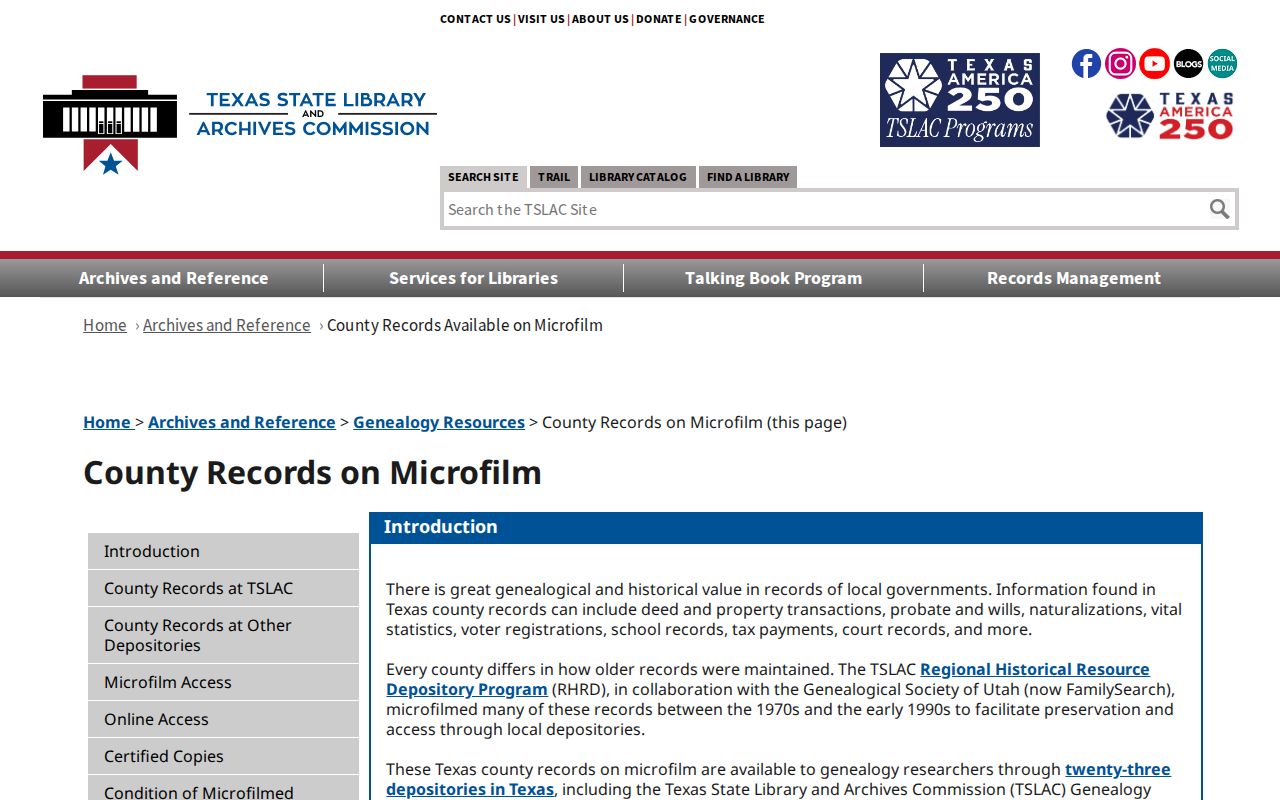
The archives-search image reinforces the need to request a named record series and date range. It does not promise that every county volume has a digital image.
Fort Bend Historical Commission folders for deeds, wills, tax assessments, United States census material, cemeteries, genealogy, and funeral notices may offer a further lead. Ask for an exact folder or file and record its citation. Do not treat a folder label as a complete person index.
Note: When a source is absent, write down the search key, source date, and record type tested before moving to a different custodian.
Missouri City Past Residents and Lawful Use
A house-history search is for family history, property curiosity, estate or heir research, and understanding a dated record. It is not a reason to track or contact a living person. Texas public-record access has field-level limits: protected voter addresses, sealed or redacted court material, and other restricted information remain unavailable even when a related index is public.
Lawful personal use. Keep Missouri City past-resident research focused on the record and its date. Do not use a historic address trail to stalk, harass, threaten, or harm anyone.
A jail listing is a current detention inquiry, not an address-history roster, and an arrest or booking is not a conviction. Likewise, a registry or court title needs its own status and disposition context. Those records should not be used to make claims about who lived at an address in the past. Stop at the official public endpoint and retain only the facts the source supports.