
Missouri City City Directory Collections
No separately published Missouri City municipal run was located in the reviewed official sources. The practical shelf is regional. The strongest match is a Southwest Houston suburban telephone-directory sequence that includes Missouri City alongside Stafford, Sugar Land, and Richmond. A broader Greater Houston residence-white-pages run reaches further back. Texas State Library and Archives Commission, or TSLAC, also lists Houston-area holdings, but its catalog should be checked item by item. Its local listing does not establish a standalone Missouri City sequence.
| Collection | Years | Where Held | Access |
|---|---|---|---|
| Southwest Houston suburban telephone directories | Aug. 1975, 1980, 1985, 1986, Nov. 1987, Jan. 1991, Mar. 1992-Mar. 2005 | UT Briscoe Center citation | Catalog and directory-record access |
| Greater Houston residence white pages | 1956-2005, many years | UT Briscoe Center citation | Check the exact cited edition |
| Houston-area city-directory holdings | Cataloged local holdings, including selected historic Houston runs | TSLAC reference reading room, Austin | Catalog and in-person route; staff do not provide telephone searches or collection scans |
The missing dedicated run matters. It means an absent Missouri City listing may reflect regional editorial scope, an unlisted telephone, a variant name, or a skipped edition. It does not prove that a household was absent. Search the regional place label and preserve the catalog's exact title and issue date.
Note: Treat the collection table as a starting map, because the catalog entry and the scanned volume can describe coverage differently.
Missouri City Regional Telephone Directories
The Southwest Houston suburban telephone-directory citation identifies Southwestern Bell or SBC issues in the listed years and places Missouri City in a shared suburban market. Its citation also supplies 281, 713, and 832 area-code context. That is useful when a copied number looks unfamiliar, but an area code is not proof of a street address or person. Read it only as part of the printed directory's period evidence.
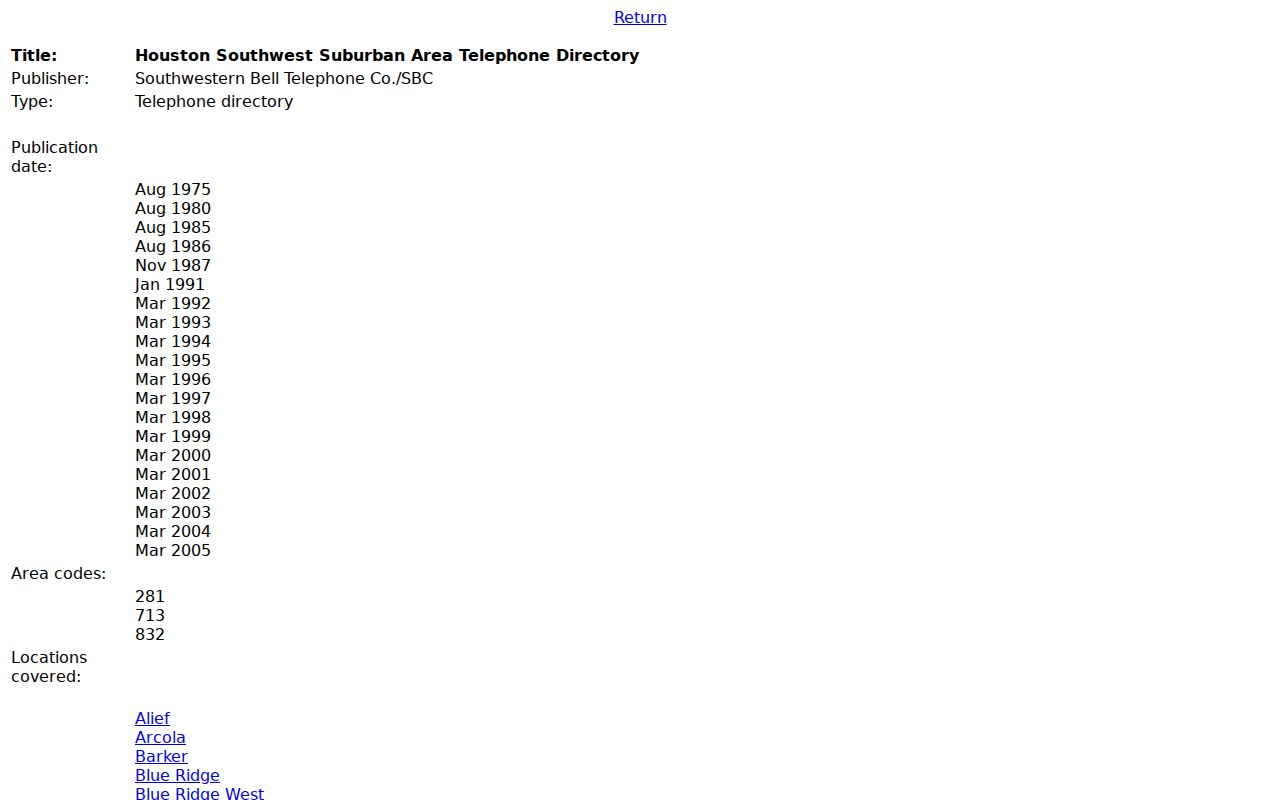
The citation screenshot helps distinguish the regional telephone sequence from a city-only publication. It also makes clear why Missouri City research may require checking Stafford, Sugar Land, Richmond, and Houston labels.
The Greater Houston residence-white-pages citation covers many years from 1956 through 2005. Do not assume it was issued every year or that every edition has the same geographic reach. Open the cited year, note its location wording, and compare the address with the other records from that period.
Search Missouri City Volumes at Briscoe
The UT Briscoe directory search provides a location field, directory-type choices, year-from and year-to controls, and a Browse option. Its types include telephone white and yellow pages, residential white pages, business yellow pages, municipal directories, and other materials. For regional volumes that cover Missouri City, begin with the regional location and set a narrow date range. A broad search can hide the relevant run among Houston material.
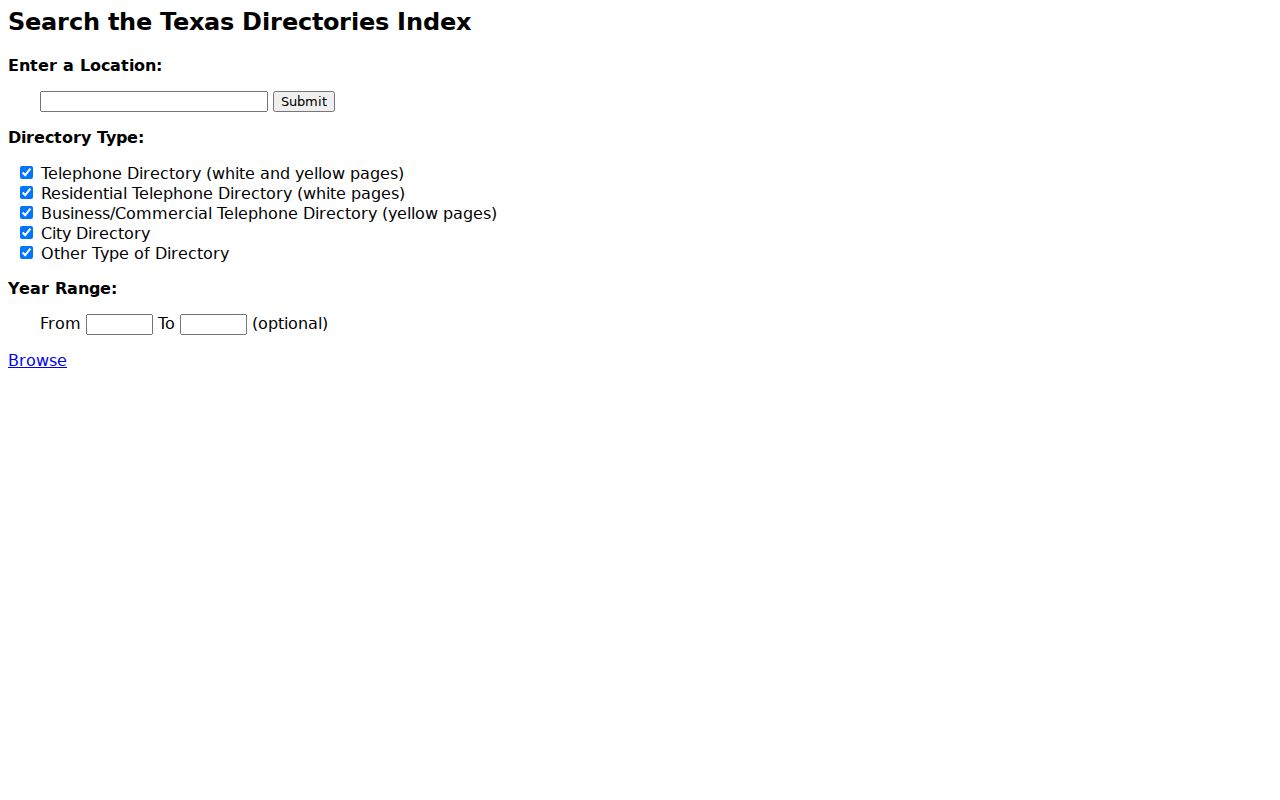
The search-interface image shows why location, format, and year belong in the same search note. Save the returned catalog title before moving to an entry or scan.
Search once with the full name and again with initials or a spouse's surname where the printed edition suggests it. Then capture the edition date, publisher, page, and the source URL. An OCR result or catalog fragment is a lead, not a substitute for the actual page image.
Reading a Missouri City City Directory Entry
TSLAC explains that these historical volumes commonly hold a name, address, telephone number, and spouse, with occupation and other status notation appearing in some editions. Each edition sets its own conventions. Read the front matter and abbreviation key before interpreting a mark. A household may be listed under one person, and a telephone-directory entry may be thinner than a full municipal entry.
| Name | Record the spelling, initials, suffix, and any spouse or household notation exactly as printed. |
|---|---|
| Address | Preserve house number, street spelling, directional term, unit, route, or subdivision label. |
| Telephone | Keep the number and printed area-code context, but do not treat it as a permanent identifier. |
| Occupation or status mark | Transcribe only if the edition prints it, then consult that volume's key for meaning. |
| Citation | Keep title, publisher, edition date, page, and a scan or catalog reference. |
- Criss-cross directory
- A reverse section organized by street or address rather than by surname. The located research treats it as a directory method, not proof that a particular Missouri City criss-cross volume survives.
- Householder index
- An alphabetical list centered on the person identified as the household contact. Other people at the address may be omitted.
- Abbreviation key
- The volume's own explanation of shortened words and marks. Photograph or transcribe it before relying on a notation.
A listing supports only what it actually prints on that edition date. It does not settle legal ownership, establish continuous residence, or prove that two same-name entries are the same person.
Missouri City Phonebook Directory Dates
The located suburban sequence starts with an August 1975 issue, then moves through 1980, 1985, 1986, November 1987, January 1991, and March issues from 1992 through March 2005. The cited run connects Missouri City with 281, 713, and 832 telephone-area context. Record the month as well as the year. A January and March entry can capture a move or listing change that a year-only timeline would blur.
- Write down the exact directory edition and page for the earliest known listing.
- Check the next located regional issue, not an assumed annual issue, for the same spelling and address.
- When the address changes, compare the old and new street text with a plat, deed, or map record.
- Keep area-code changes as telephone context, then confirm the household through a separate dated source.
Missouri City's railroad-townsite origin and later suburban subdivision growth help explain why older sources can use a rural route, regional postal place, or subdivision name. The city's historical material describes the townsite and later growth, but it does not supply a complete directory-year chronology. Preserve the language used in the original source rather than converting every earlier place reference to current city limits.
Missouri City Library Directories
Fort Bend Libraries Genealogy and Local History is based at George Memorial Library in Richmond and offers research assistance, local history, and FamilySearch access. The Missouri City branch is a convenient local branch, while George Memorial is the specialist collection. Its noncirculating materials include local books, vertical files, newspapers, photographs, census indexes, and microforms. A directory question that cannot be answered on the web may need a librarian, reader-printer, and a catalog check.
In-house holdings include Fort Bend newspapers beginning in 1911, the Brookshire Times from 1899 to 1984, selected regional newspaper runs, and census material. The microform collection includes southeastern United States censuses through 1930, Texas Soundex for 1880 through 1920, vital indexes, government records, and newspapers. These are companion sources for a directory date, not replacements for the published page.
Note: Library local-history items do not circulate, and listed reader-printer copies cost 10 cents per page.
Trace Missouri City Households Across Directories
Build a household trail from known facts toward uncertain ones. The library's known-to-unknown method is a good guardrail: start with a dated address or name, then add only records that agree on meaningful details. Directories supply snapshots between censuses, but the federal release rule leaves broad decennial gaps and does not make every address easy to find. A disappeared listing can mean a move, death, unlisted phone, altered spelling, or a skipped regional edition.
- Locate the first regional directory issue that plausibly names the household and cite the entry in full.
- Compare later located issues for spelling, address, spouse notation, and telephone change.
- Pair the directory date with the nearest available census or library microform finding aid, keeping the census date separate.
- Use a recorded deed, plat, or tax-roll reference to test an address change without assuming ownership equals occupancy.
- Close a dated trail with an obituary, burial, probate, or newspaper citation when that source actually names the person or place.
For a current name check after the historical work, the Missouri City resident lookup route uses different record systems. Keep those results separate from a historical listing until dates and identifiers line up.
Missouri City Obituary Clues
The Fort Bend Libraries obituary database searches names, birth and death dates, cemetery, and notes. A hit may include a scanned obituary, or it may be only an index. Record the newspaper, date, page, scan status, and source type. An obituary can support a date or family relationship hypothesis, but it is not a civil certificate or proof of a full address history.
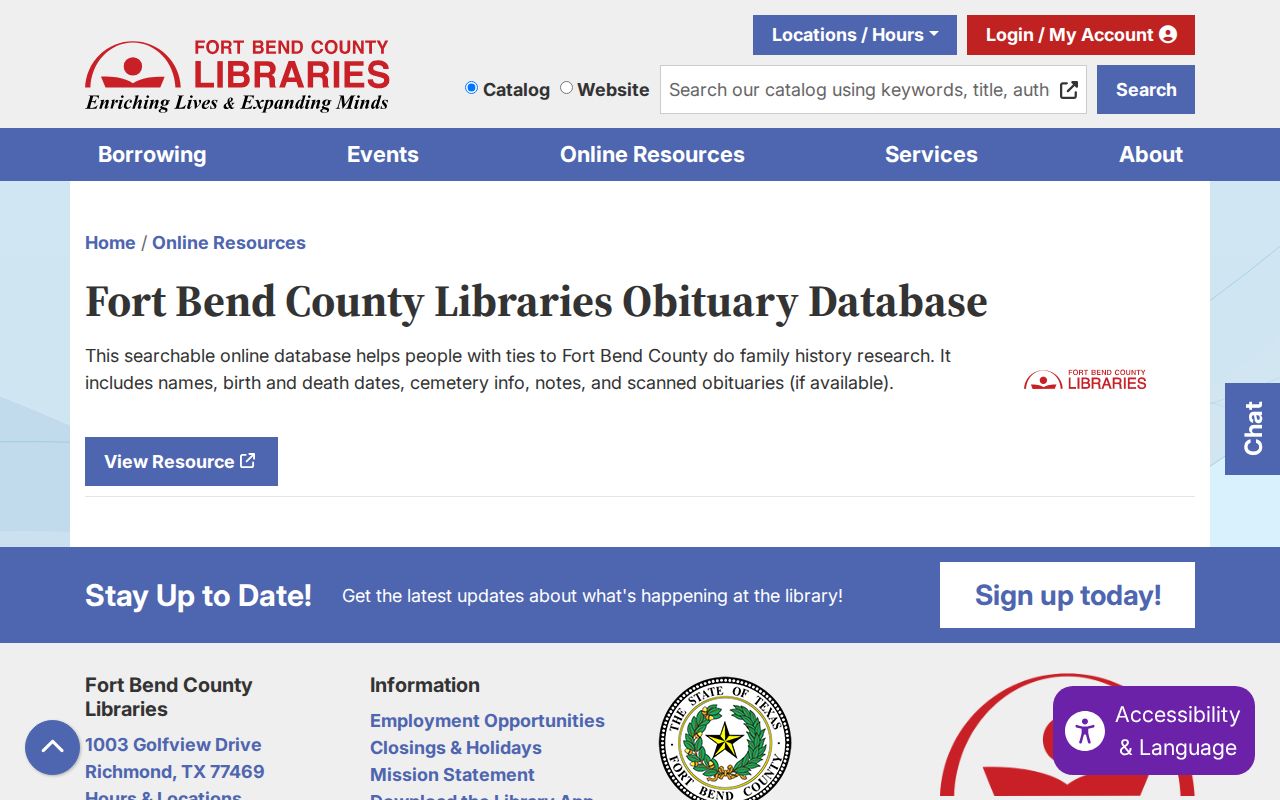
The database screenshot shows a companion search layer for a household timeline. Use a match to locate a dated notice, then compare the notice's place wording against the directory edition.
Fort Bend Historical Commission archives offer another route. Its document index labels folders for deeds, wills, tax assessments, United States census material, cemeteries, genealogy, and funeral notices. Request an exact folder or file rather than assuming every label is a complete online name index.
Missouri City Archive Research Limits
Fort Bend Historical Commission archives hold local papers, photographs, and artifacts, and the collection index can make a targeted request more useful. Its screenshot is a reminder that archive labels are a holdings map. For older property context, TSLAC tax rolls may show land or personal property and resident or nonresident classification, but the research warns that the rolls are incomplete, missing for some years, and not indexed.
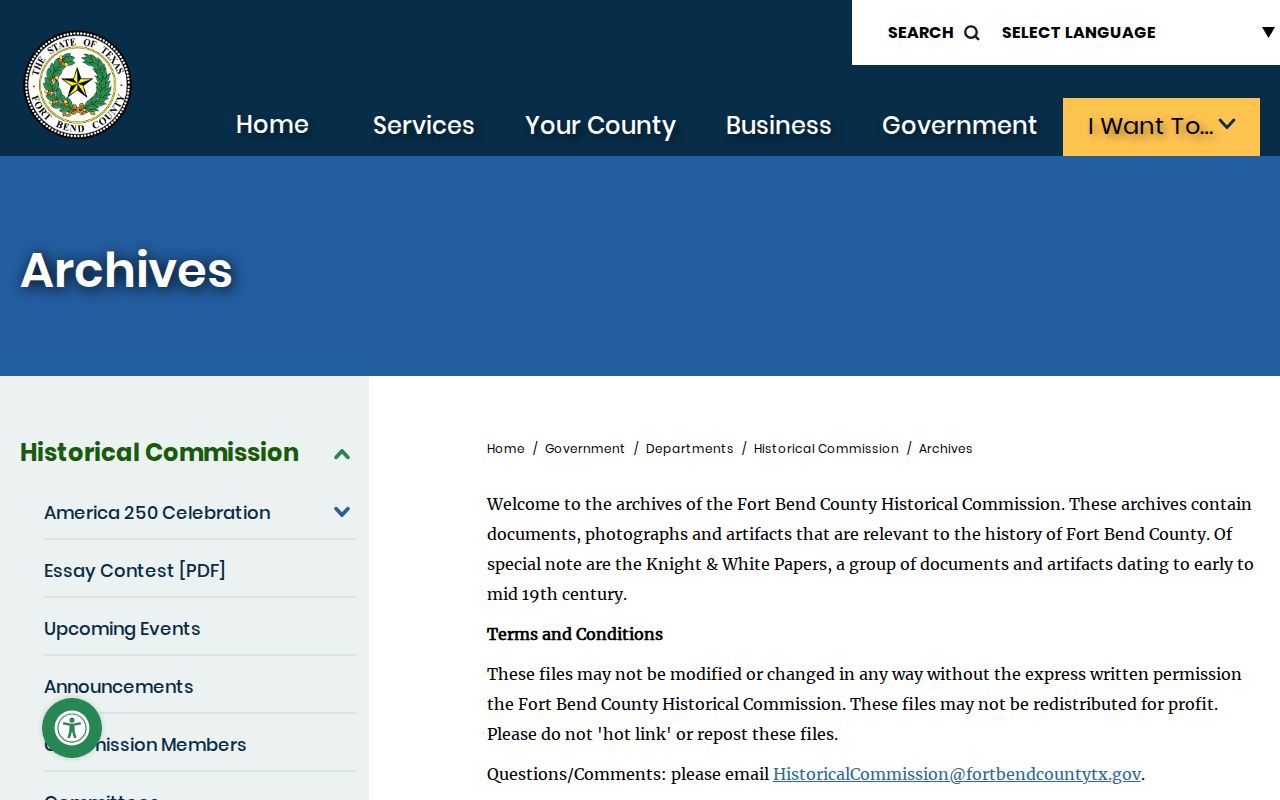
The archives image connects a printed directory lead to local folders that may hold a deed, will, tax, census, cemetery, or funeral-notice clue. It does not turn any archive label into a person record.
The practical limits are clear: no dedicated Missouri City city-directory series was verified, TSLAC local holdings are not a promised standalone run, and a directory entry is not proof of continuous residence. Keep a dated evidence list, name the gap, and ask the holder about the precise volume or folder.